THEY STOLE MY RETIREMENT—UNTIL HE STRUCK ME IN MY OWN FOYER
Chapter 1 - The Plaque Under the Entryway
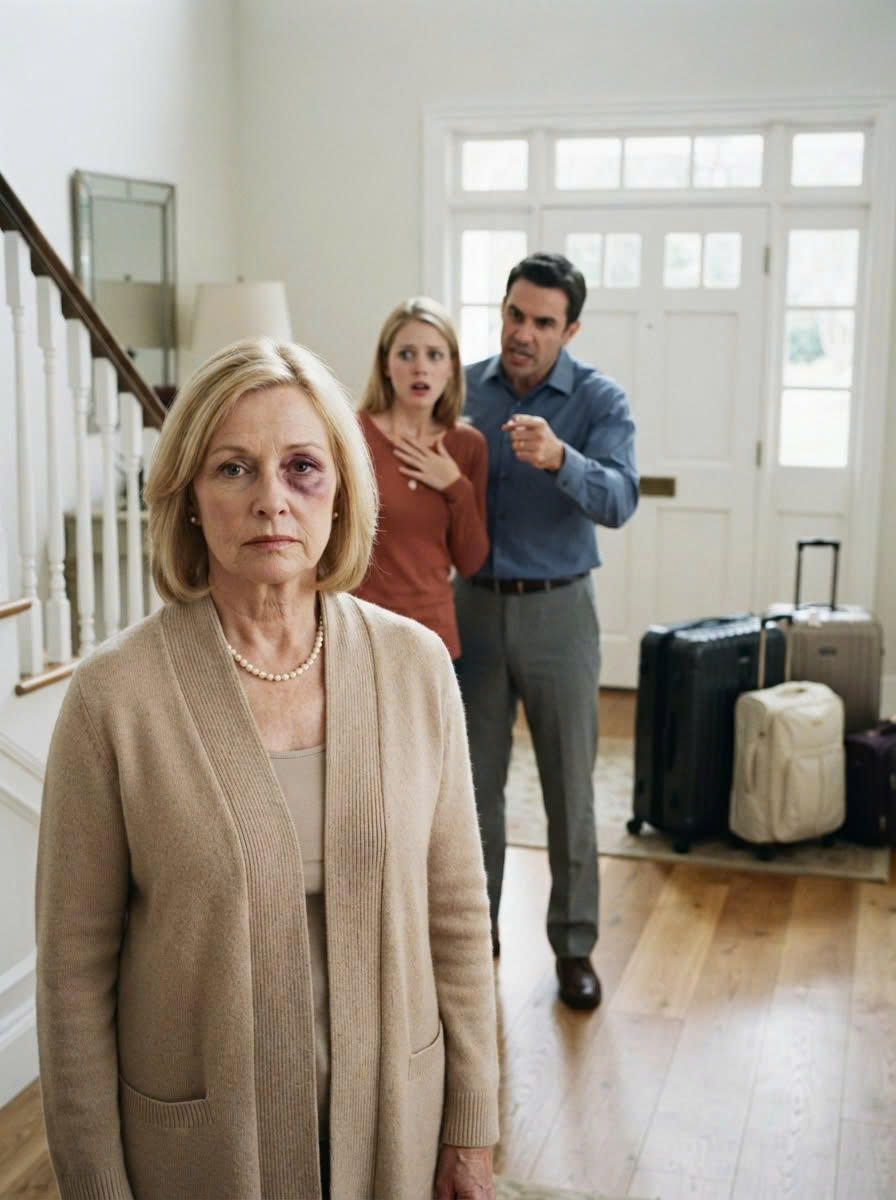
The sting on my left cheek was hot, standard friction against age-thin skin. But the marble console behind me held firm against my lower back, and so did I. Sixty-eight years on this earth—thirty of them spent running a forensic accounting practice—do not evaporate because a thirty-two-year-old man who rents European sedans loses his temper.
Trent was breathing through his teeth. His leather loafers were coated in gray dust from my driveway. On the floor between us lay the crushed plastic shell of a ring camera—a ninety-dollar consumer gadget he had just stomped into five useless fragments.
“There,” Trent said, his voice dropping into that smooth, rehearsed register he used for his online promotional seminars. “No proof. You lost your balance, Eleanor. Age-related vertigo. It happens to elderly women who live alone in houses too large for them.”
Beside him, Rachel stood with her hand resting on the sleeve of his tailored jacket. She didn't look at my face. She looked at the floor, at the polished herringbone oak I had chosen with her father twenty-two years ago.
“Mom,” Rachel murmured, her voice flat, devoid of the warmth that used to define her. “Just give us the key to the guest house. Trent’s firm is undergoing a routine audit. The liquidity is tied up in international clearing houses. It’s thirty days. You have three empty bedrooms.”
“I have four,” I corrected, my voice level, stripped of any tremor. “And none of them are available to a man who puts hands on me in my own foyer, nor to the daughter who stands by and provides his alibi.”
Rachel’s eyes snapped up. “We gave you everything, Mom! Trent gave me a vision! We sold the house dad bought me because this investment yields thirty percent quarterly! Do you know what it’s like to live with someone who actually aims for greatness instead of sitting in a house full of old ledgers?”
“Your father didn’t buy you that house, Rachel,” I said softly. “I bought it. I signed the deed release six months before he died. And the five hundred thousand dollars you handed Trent two weeks ago was the equity accrued over twelve years of my quiet subsidy.”
Trent stepped forward again, closing the distance between us until I could smell the expensive tobacco and cedar cologne he used to mask the desperation that follows failed leverage.
“Listen to me, Eleanor,” Trent whispered, leaning down so his mouth was inches from my ear. “You’re an old woman in an oversized property. The court will see a confused widow who misremembered a family disagreement. You hand over the security codes for the annex, or I make sure Rachel files for adult guardianship. We’ll have a court-appointed trustee managing this estate by Friday.”
Rachel said nothing. She reached into my purse, pulled out my smartphone, and dropped it into her coat pocket.
“We’ll be in the guest wing,” Trent said, turning toward the French doors that led to the courtyard. “Don’t make a scene, Eleanor. It’s bad for your heart.”
They walked down the loggia toward the west wing, their heavy suitcases dragging across the limestone pavers.
I did not scream. I did not chase them. I walked down the hall to the study, past the brass plaque my former partners had given me upon my retirement five years ago: ELEANOR VALE—RETIRED, NOT DEFEATED.
I opened the bottom drawer of the mahogany desk. Beneath a stack of archival tax returns lay a small steel box. Inside was not a weapon, nor a backup phone. Inside was a secondary hard drive connected via CAT-6 cable to a commercial-grade, multi-lens closed-circuit system installed six years ago by the commercial security firm that monitored my old accounting office.
The ninety-dollar camera Trent had smashed on the floor was a decoy—a visible consumer device meant to draw the eye of low-level intruders. The real camera sat concealed within the carved wooden frame of the brass plaque itself, capturing four thousand pixels per inch at sixty frames per second, with direct, off-site cloud replication via an encrypted cellular modem hidden in the attic.
I opened the local terminal, loaded the video feed from three minutes ago, and watched Trent’s right hand swing across the frame in high-definition resolution, capturing the exact angle of contact, the audio of his threat, and Rachel’s explicit instructions to conceal the assault.
Then I reached under the desk and pulled out the hardwired landline phone—the old copper wire that no modern scammer ever thinks to disconnect.
I dialed a direct ten-digit number, bypassing the local emergency dispatcher.
“Arthur,” I said when the line picked up. “It’s Eleanor. Trent just laid hands on me in the foyer. Rachel took my mobile phone. They are currently squatted in the west annex.”
On the other end of the line, Arthur Vance—senior partner at Vance, Sterling & Croft, and my legal counsel for forty years—cleared his throat.
“Is the secondary array functioning, Eleanor?”
“It captured everything,” I replied. “Audio, video, and the intent.”
“Good,” Arthur said quietly. “Do not go into the courtyard. Do not lock the doors from the inside—let them think they hold the perimeter. I am calling Chief Miller on his private line now. We are executing the asset preservation protocol we drafted last November.”
“Arthur?” I added.
“Yes, Eleanor?”
“Include the corporate discovery motions for Trent’s ‘logistics’ entity. I want every ledger opened by morning.”
“They picked the wrong forensic accountant, Eleanor,” Arthur said. “Stay in the study.”
I hung up the receiver, adjusted my collar in the mirror, and sat down at my desk.